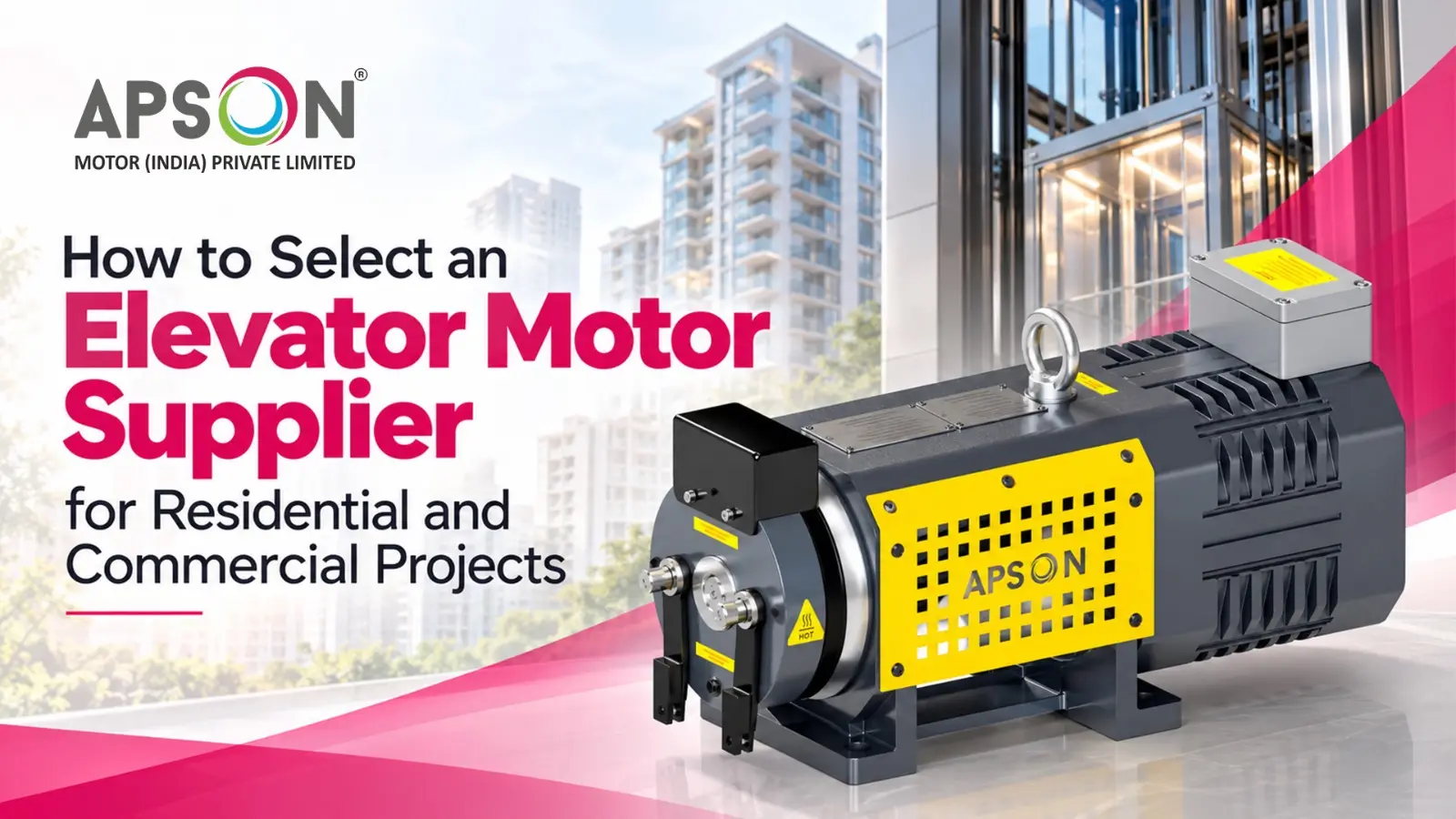
How to Select an Elevator Motor Supplier for Residential and Commercial Projects
Nobody grows up wanting to choose a lift motor. I certainly didn’t.
But if you’re a builder, a contractor, or a society secretary who got stuck with this job, you’ll have to find an elevator motor supplier at some point. And it’s confusing. Everyone says they’re the best. Everyone has a brochure.
So here’s how I’d think about it. It’s not a perfect method, just what makes sense to me.
Start with your own building first
Before you call anyone, know what you need. Sounds obvious, but people skip this all the time.
How many floors? How many people will use it every day? A 6-floor apartment block and a 14-storey office need very different machines.
Write it down. Load in kg, speed in metres per second, number of floors, rough daily traffic. Even a messy note helps, because the first thing any supplier asks is exactly this.
If you can’t answer these, your lift consultant can. Call them first, then the suppliers. Not the other way round.
Related : https://apson.co.in/products
Homes and offices are not the same game
Homes want quiet and smooth. Also not too expensive. A society lift does a few hundred trips a day, and the usual complaint is noise, or a small jerk when it stops.
Offices and malls are rougher. Lifts run from morning till night, there’s a crowd at 9:30 and again at 6, and downtime means angry tenants calling the owner. A commercial elevator motor has to take that kind of load without overheating or needing attention every few months.
Both are “lifts”, but the job is totally different. So a company that’s great at one may be average at the other. Ask what projects they’ve done that look like yours. Not just the biggest ones on their website, the similar ones.
The capacity thing
This trips people up more than you’d think. The elevator motor capacity you need depends on the load, the speed and the number of floors. It’s not just one kW number on a quotation.
Too small and the motor runs hot and wears out early. Too big and you’ve paid extra for nothing. Neither is fun.
Don’t guess. Share your shaft details and let them suggest something, then ask why. A decent person will explain it in plain words. If the answer is just “trust me, sir”, hmm, be a little careful.
Is it a maker or a middleman?
Some companies make the machines. Some buy and resell. Some only assemble parts. All of them can be okay, but they’re not the same thing.
A real elevator motor manufacturer usually has its own plant, its own testing and engineers who can answer a tough question without calling someone else. A reseller often can’t, or goes quiet and says “I’ll check and tell you.”
That doesn’t mean you should avoid resellers. Just know who you’re dealing with. And ask whose warranty it actually is, because that gets confusing later.
Price, yes, let’s talk about it
Everyone’s first question is the elevator motor price in India. Fair enough. But there’s no single number. It changes with capacity, speed, motor type, brand and what’s included in the package.
Geared or gearless changes it a lot too.
So don’t compare random quotes. Ask three suppliers for the same specs, and check what’s actually inside the package. Brake, encoder, sheave, frame. One quote can look cheap just because half the items are missing.
I’ve seen a quote that was 30 percent lower, and then “extras” kept getting added. By the end it wasn’t cheaper at all. It was just slower to find out.
What a good one actually does
A good elevator motor supplier won’t rush you. That’s the first sign.
They’ll ask about your building before they quote. They’ll share test reports without drama. They’ll tell you honestly when a cheaper option is enough, even if it earns them less. That last one is rare, and I really trust it when it happens.
Also, get everything in writing. Specs, delivery time, what’s included, what’s not. Phone promises disappear very fast when there’s a problem.
Small thing: see how quickly they reply. If they take four days to answer a quotation request, imagine the response when your lift is stuck.
Service is where you find out the truth
Nobody checks this, and it hurts later. The elevator motor supplier you pick today is the one you’ll be calling at 10 pm when the lift stops with people inside. Or at least with one angry resident on the line.
So ask a few boring questions. Do they have service engineers in your city? Do they keep spare parts or order them every time? How fast do they actually respond? Not what the brochure says, what their other customers say.
If you can, call one or two of their existing clients. It takes ten minutes and tells you more than any presentation.
A slightly costlier company with a local team is often better than a cheaper one 800 km away. Even a small part can keep a lift down for a week if it isn’t available.
Read the warranty properly as well. The number of years is only half of it. What’s covered, what’s not, and who pays for the visit?
Where Apson Motors comes in
Since this is on our own site, I’ll be upfront. Apson Motors should be on your shortlist if you want gearless machines made in India.
Check apson.co.in, see the range, ask for specs for your project, and compare them with other options. Please compare. I’d rather you ask hard questions now than get unhappy later.
And any elevator motor supplier, us included, should be able to answer the same basic things clearly: testing, warranty, service, spares. If the answers sound foggy, move on.
Mistakes people keep making
Choosing an elevator motor supplier only because the quote is lowest. I know this is repeated everywhere, but it’s repeated because it keeps happening.
Placing the order before the shaft size is final. This one is painful. A few centimetres of difference and suddenly the machine doesn’t fit the way it was planned.
Trusting a friend’s recommendation without checking. “My cousin’s building has the same lift and it’s fine.” Maybe so. But his load, his speed, his daily traffic might be nothing like yours.
Skipping the consultant to save a little money. Then paying ten times that to fix something later.
And not reading the fine print. Boring, yes. Useful, also yes.
Okay, so what now
Honestly, there’s no perfect formula. Know your building, ask a lot of questions, compare at least three, and get things in writing.
Then choose the company you feel you can call at 10 pm without dreading it.
That’s my whole method, more or less.
FAQs
What should I look for in an elevator motor supplier?
Look at their testing, warranty, spare parts and service support in your city.
Is the cheapest quote safe to choose?
Usually not. Check first what’s missing from the package.
Do homes and offices need different motors?
Yes. Offices need stronger, more durable machines because lifts run all day.
Can one elevator motor supplier handle both residential and commercial projects?
Many can, but ask for past projects similar to yours.
How do I know the right motor size for my lift?
It depends on load, speed and floors. Share your shaft details and let the supplier explain their choice.